
Start with your take-home pay, not your salary
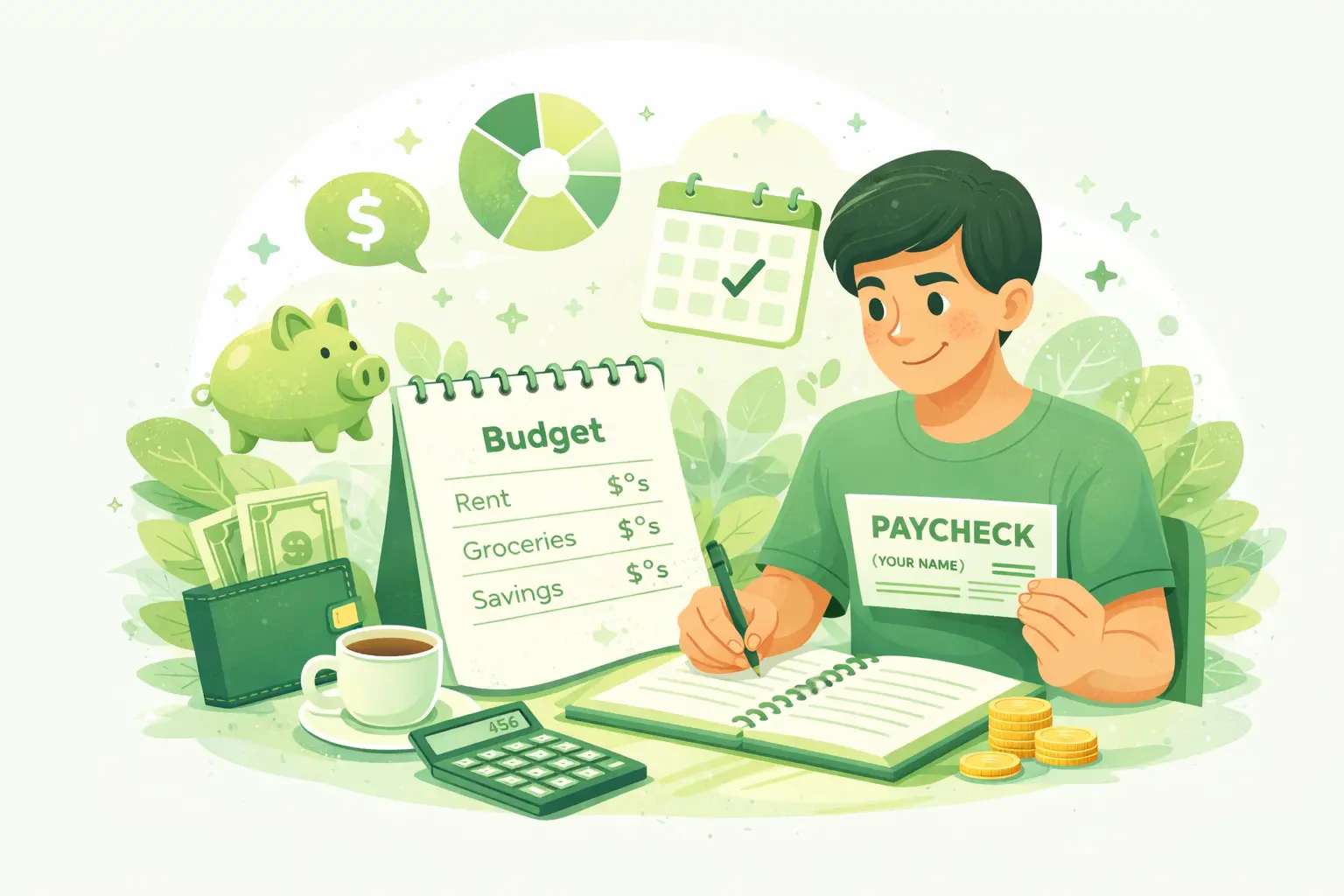
Before you budget anything, make sure you know the number you are actually working with.
Your salary is the number on your offer letter. Your take-home pay is what actually lands in your account after taxes, Social Security, Medicare, health insurance, and any other deductions.
That gap catches a lot of people off guard.
A rough example: a $40,000 salary works out to about $3,333 a month before deductions. Depending on where you live and how your withholding is set up, your actual take-home could land much closer to $2,600 to $2,800.
The IRS withholding estimator can help you get a clearer picture, and your pay stub will show you exactly where the rest is going.
Your budget should always be built on the money that actually hits your account.
Use a simple framework before you build a complicated one
If this is your first time budgeting, simplicity is an advantage.
One of the easiest places to begin is the 50/30/20 rule:
- 50% for needs
- 30% for wants
- 20% for savings and future goals
If you want a fuller breakdown of how that framework works in practice, our guide to the 50/30/20 budget rule in real life can help.
Here is what the split looks like on a $2,800 monthly take-home:
| Category | Percentage | Monthly Amount |
|---|---|---|
| Needs | 50% | $1,400 |
| Wants | 30% | $840 |
| Savings and future | 20% | $560 |
It is not a perfect formula for everyone. If you live in an expensive city, your needs may run higher than 50%. If you are living at home, your savings rate may be able to go much higher. But as a first framework, it is clear, forgiving, and easy to use.
Cover your essential categories first
Your needs are the things that keep your life stable.
That usually includes:
- rent or housing contribution
- groceries
- transport
- utilities
- phone and internet
- minimum debt payments
- insurance
Housing is usually the biggest one. A common rule of thumb is to keep housing costs around or below 30% of income when possible, but in many places that is easier said than done. Treat it as a guideline, not a moral test.
For food, the USDA's monthly food cost reports can help you sanity-check your grocery budget. They are especially useful if you are budgeting on your own for the first time and have no idea what "normal" looks like yet.
The key is not perfect categorization. It is making sure your essentials are covered before the rest of the month starts filling itself up.
Give your fun money a real place in the budget
This is where a lot of first budgets go wrong. People either spend freely and hope for the best, or they try to be so strict that the budget collapses by week two.
You are allowed to enjoy your paycheck.
Your wants category might include:
- dining out
- streaming subscriptions
- hobbies
- weekend plans
- clothes
- personal care beyond the basics
- coffee shops and social spending
The point is not to remove all of it. The point is to decide ahead of time how much room it gets.
That way, spending feels intentional instead of blurry.
Build savings into the plan from the beginning
This is the part that is easiest to postpone and hardest to catch up on later.
If your budget can make room for it, your savings bucket should start working for you right away.
A good early order is:
1. Start your emergency fund first
Even a small emergency cushion changes your options when something goes wrong.
Our guide on how to build an emergency fund when money is tight walks through that in more detail, but the short version is this: start with a realistic first milestone, automate what you can, and let small amounts count.
2. Contribute enough to get any employer match
If your job offers a retirement match, try to contribute at least enough to get the full match. That is part of your compensation.
Investor.gov explains why starting early matters so much: compound growth gives money in your twenties more time to build.
3. Set one short-term goal
After emergency savings and retirement basics are underway, let the rest of your savings work toward something specific.
That could be:
- moving costs
- a travel fund
- a new laptop
- a car down payment
- a future housing cushion
Named goals are easier to stick with than vague "save more" intentions.
If you are thinking about a Roth IRA, the IRS keeps the current Roth IRA rules and contribution limits here. Check the current limit before you build it into your plan.
A simple first-paycheck budget example
Let’s say Alex just started a first full-time job and takes home $2,750 a month.
Here is one way a simple budget could look:
| Category | Item | Amount |
|---|---|---|
| Needs | Rent (shared apartment) | $750 |
| Groceries | $280 | |
| Transport | $120 | |
| Phone | $65 | |
| Internet | $50 | |
| Insurance | $20 | |
| Student loan minimum | $90 | |
| Needs total | $1,375 | |
| Wants | Dining out and coffee | $200 |
| Streaming | $45 | |
| Gym | $40 | |
| Clothes and personal care | $150 | |
| Entertainment and social | $200 | |
| Miscellaneous wants | $190 | |
| Wants total | $825 | |
| Savings | Emergency fund | $200 |
| Retirement contribution | $200 | |
| Travel goal | $150 | |
| Savings total | $550 |
No budget example will match your life exactly. The point of an example like this is not to copy it line for line. It is to show that every dollar can have a job without making your life feel joyless.
Five first-paycheck mistakes to avoid
1. Letting lifestyle inflation start too early
The first big trap is upgrading everything at once because you finally can.
New income can make new spending feel justified. Sometimes it is justified. But Investopedia defines lifestyle inflation as spending rising as income rises, and it gets expensive fast when savings never get a chance to start.
Give yourself room to enjoy your money, but do it inside a budget you chose on purpose.
2. Budgeting from gross pay instead of take-home pay
This one causes problems quickly. If you build your monthly plan from the salary number instead of the deposit amount, the whole budget is off before the month begins.
Use what actually arrives in your account.
3. Not tracking where the money is actually going
A budget is only useful if you can tell whether it is working.
You do not need a complicated spreadsheet. You just need a system you will actually use. If you want something simpler, how to track expenses without a spreadsheet is a good place to start.
4. Delaying your emergency fund
It is easy to tell yourself you will set this up "next month." But next month tends to keep moving.
Even a small automatic transfer matters. Starting with $25 or $50 is still starting.
5. Treating your budget like punishment
The best budget is not the strictest one. It is the one you can keep using.
A good budget should help you feel clearer, not constantly guilty.
Frequently asked questions
How do you budget for a monthly paycheck?
Start with the amount that actually hits your account, then split it into needs, wants, and savings. Cover fixed essentials first, choose a realistic amount for flexible spending, and move savings automatically so the month has structure from the start.
What is the 70/20/10 rule money?
The 70/20/10 rule is a simple budgeting framework where about 70% of your take-home pay goes to spending, 20% goes to savings or debt payoff, and 10% goes to giving or extra goals. It is not the only good method, but it can work well if you want something simpler than tracking lots of categories.
How to budget when your paycheck to paycheck?
Focus on the next few priorities in order: housing, food, transport, minimum bills, and a very small buffer if possible. When money is tight, the goal is not a perfect split. It is making sure the essentials are covered, cutting quiet leaks quickly, and giving every remaining dollar a job.
How much of a $1000 paycheck should I save?
If you can save 20%, that would be $200 from a $1,000 paycheck. NerdWallet points to 20% as a common savings-and-debt target within the 50/30/20 budget, but if that is not realistic yet, start smaller and stay consistent. Even saving $50 to $100 per paycheck helps build the habit and gives you a base to grow from later.
Is saving $500 a month a lot?
For many people, yes. Saving $500 a month adds up to $6,000 over a year, which can make a real difference in an emergency fund, debt payoff plan, or short-term goal. What matters most is whether that amount fits your income and still lets you cover your essentials.
Your first paycheck is a starting line
Getting your first real paycheck is exciting because it represents more than money. It represents progress, independence, and possibility.
What you do with the first few months of income matters because it starts building your default habits. The sooner you decide how your money should work, the easier it is to avoid wondering later where it all went.
You do not need a perfect budget. You need one that is simple enough to follow, realistic enough to trust, and flexible enough to grow with you.
And if you want a calmer way to stay on top of spending while you build those habits, download BudgetEase on the App Store.